
Scaling Your Money Mountain
And Finding Joy Beyond

Before the rains lashed across the Himalayas this year, I went on a trek in Uttarakhand. For someone who doesn’t quite enjoy the noise and chaos of city life, that longish journey through mountains and forests, spent together with loved ones, felt like stepping into another world. Blissful, refreshing, grounding.
Trekking and financial journeys have some strong parallels. Both are demanding. Both test your resilience. And both give you an immense sense of achievement when you make progress.
Every Journey Needs Goals
Each trek has a goal. Most, in fact, have multiple interim goals (higher camps and landmarks) and an ultimate goal (a landmark or a summit).
A map and quick itinerary of the trek
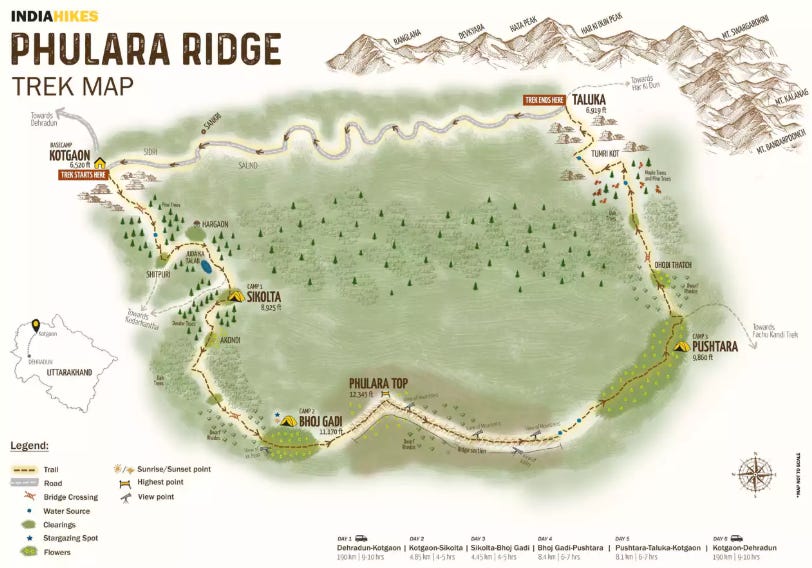
Our financial journeys work the same way: identifying specific, measurable goals ensures we have direction and a path to follow.
Retirement is the ultimate, non-negotiable summit. It happens to everyone and usually requires the accumulation of the largest corpus among all goals.
Buying a house, Children’s education, their weddings, upgrading a car – these are the smaller camps on the way.
The challenge? Many people never set these goals. And without goals, there’s no plan, no trail to follow. You end up wandering through the jungle arbitrarily, with no map. That might sound adventurous at first, but in the long run it’s dangerous. Because without any measurement of progress against life goals, you might have to slog away forever. We actually see many people having to do that in their golden, sunset years.
3Es of a Guide – Your Trust is the Fourth
When you trek, you usually have a trek lead and one or more guides. Their presence is often the difference between being lost in the jungle and staying on the right path. They know the terrain, the weather, the risks, and the alternatives. Walk with them long enough, and they also begin to understand your strengths and weaknesses.
They help you gear up the right way – right shoes, packed bags, trek poles, hydration, and oxygen checks – so you can ace the trail. But more than that, they evaluate different routes, eliminate risky ones, and sometimes experiment with small detours that could make the climb more rewarding. Eliminating risk also means slowing you down or even stopping you on narrow ledges or exposed sections. Because one wrong step can undo months of preparation, or worse, end your trek. These 3Es make all the difference.
Financial guides work the same way. At every stage of your plan, they are evaluating choices, eliminating what can hurt you, and experimenting carefully with what can help you grow. If they fail to keep you away from not only from obviously harmful products but also from shiny “new age” traps that look harmless, then they’ve failed in their core job. One wrong step here can set you back by decades.
But unlike trek guides, financial guides cannot see every place where you are stepping – unless you tell them. They need your wholehearted participation. That means being transparent about your money choices, setting clear goals (with timelines and values), and chasing them with sincerity—even where no one is watching.
Yes, sometimes the 3Es (eliminating a lot and experimenting with a little) may feel boring. But boring can be good, especially when it’s a sound process built on solid principles. The people who embrace this usually move far ahead, “summit” their goals sooner, and then climb further peaks.
Same Trail, Another Season
If someone breezed up the mountain in summer and you attempt the same trek in winter snow with the same expectations, you’re in for a shock. Himalayan winters are harsh. With wrong expectations, you’ll be looking for plush forests and meadows, but will end up getting white powdery snow everywhere, with scarce water sources and hard-to-navigate trails, even with micro-spikes on your shoes. In monsoons, it’s even worse – sudden storms, landslides, and lightning risks.
Markets also have their seasons. After COVID, every asset class seemed to climb nonstop. Many participants have become perennially bullish, assuming the summer warmth would never end. But markets too have their seasons. Right now, winter is here. The path is still open, but expectations must be tempered.
Choose Your Company, Choose Your Journey
The toughest trek I have ever done to date was a night hike. This is not paradoxical when seen in the right context. For most people in that group, the trek wasn’t the main agenda. An easy, one-night hike was just an excuse for a night of partying. What was supposed to be a short, simple climb turned into one of my most draining experiences.
Now, contrast that with my last trek—the Phulara Ridge in Uttarakhand. On paper and beyond, it was the hardest I’ve done so far. The group was diverse — different ages, backgrounds, experiences and fitness levels. But what held us together was a common spirit to see it through. Add in the steady hands of our guides, and we were able to push through weather conditions that were way tougher than what the trek was rated for. That shared drive made all the difference.


Money journeys are no different. As Warren Buffett puts it:
“Surround yourself with people who push you to do better. No drama or negativity. Just higher goals and higher motivation. Good times and positive energy. No jealousy or hate. Simply bringing out the absolute best in each other.”
Warren’s simple words. Mostly not easy to live by. But if you can get your company right—people who nudge you forward instead of pulling you back—the climb, no matter how tough, becomes achievable.
Preparation Makes the Climb Possible
Good trekking companies insist on proof of preparation. They ask us to download fitness tracking apps like Nike and Strava and submit a minimum number of activity logs before the trek. They also require a fitness certificate from a doctor. Why? Because if you’re unfit, even the best plan, the best guide, or the best equipment cannot carry you to the top. Among all the factors that impact trek outcomes, I think fitness stands out as both very important and the most within your control, though it entails a lot of sacrifice.
The same applies to financial outcomes. Preparation here also begins—and continues—with sacrifice. You give up a part of today’s comfort, so you can grow the surplus thus generated. Simple but demanding. Those surpluses become seeds, which grow into saplings, then trees, and eventually shade and fruit for tomorrow.
And just like on a long trek, you also prepare yourself to be patient. Very patient. Because trees don’t bear fruit overnight. They take time, care, and consistency. But that’s the nature of anything worthwhile—it demands preparation first.
Beyond the Summit – What Lies Ahead?
What do you do when you finally reach your ultimate goal? You cherish not only the destination, but the fantastic journey that brought you there. That’s why it’s important to make our journey worth cherishing as we go along. Stay deeply focused on the goal, yes—but don’t forget to enjoy the trail itself. Celebrate the small milestones, the interim camps, and then, of course, the ultimate achievement.
And then what? Another trek, another goal – perhaps more arduous, more ambitious, with an even bigger sense of accomplishment? Or do you simply sit back, content, whispering to yourself: Been there, done that?


This, I feel, is the larger question—what happens when the seeker finds all that he seeks? Surely, seeking endlessly for the sake of seeking cannot be the answer. To me, this is the latest point where the journey should gently turn spiritual for everyone.
And this also, perhaps, is the point in the write-up where I am drifting out of the syllabus. Pardon the detour - I didn’t set out to write anything spiritual here, but mountains often leave me blissfully humbled, so I couldn’t help it. 😊By the way, your trust has a similar effect—so thank you for being part of this journey, and for adding as much to me as I hope I add to you.